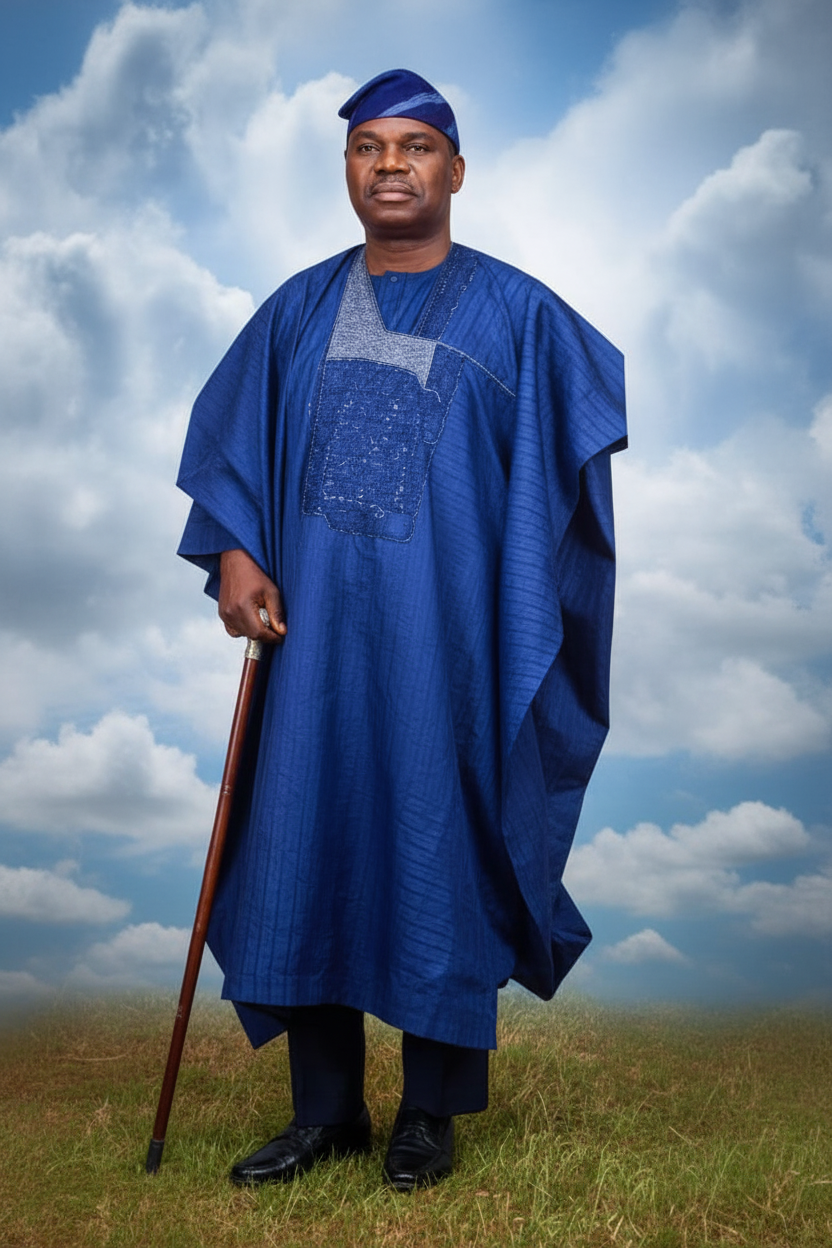
The Asiwaju of Ijebuland
Chief Samuel Olatubosun Shonibare
8th January 1920 — 17th January 1964
Scroll
The Asiwaju of Ijebuland
8th January 1920 — 17th January 1964
Chapter I
If you drive through Maryland, Lagos today — past the flyover, the filling stations, the endless traffic — you are driving through one man's vision.
Maryland Estate. The name is everywhere. But the man who built it? Chief Samuel Olatubosun Shonibare. Born in 1920. Dead at forty-four. And in those forty-four years, he accomplished what most men could not manage in a century.
He was born in Ijebu Ode — the last son of Sadiku Odeboju Shonibare, who died when the boy was just six months old. The name Shonibare, a nickname his father preferred to his birth name, translates roughly as "be careful who you befriend." Raised by a widowed mother, Adekatu Shonibare née Alli, in the family compound at Italajoda, the young Olatubosun was educated to Standard Six — the equivalent of today's JSS 3 — before setting out for Lagos.
"He was neither an Afobaje nor even a chief then, but he was a very big shot, a prominent Ijebu son who was concerned about the ultimate progress of the town." — Oba Sikiru Adetona, Awujale of Ijebuland, in his autobiography
Chapter II
He joined the United Africa Company as a clerk in Ibadan, earning one British pound a month and riding a white Raleigh bicycle to work each day.
But this was not a man who stayed at the bottom of anything. He took correspondence courses in accounting, rose through the ranks to chief clerk, then office manager of the technical department. His superior was Chief Adewole Olukoya — the first African manager UAC had ever appointed.
Olukoya was so impressed by his protégé's ability and reliability that he introduced him to his eldest daughter, Princess Alice Olaperi Olukoya. The two young people met and fell in love. They married in a white wedding in Ijebu Ode in 1946.
In rapid succession, the couple had eight children in sixteen years: Ronke, Yinka, Taiwo, Kehinde, Idowu, Alaba, Tokunbo, and Gbeyinteinshe. At the birth of Alaba — the long-awaited boy — Shonibare was so overjoyed that he bought his wife a five-carat solitaire diamond ring mounted in white gold, shaped like a thistle flower.
Chapter III
When Shonibare left UAC in 1951, he didn't leave empty-handed — he left with a vision.
He was appointed to run the Amalgamated Press, publishers of the Daily Service — the political voice of the Action Group. Under his leadership, they launched the Sunday Express and the Daily Express, forging a partnership with Lord Thomson's Times of London that brought Fleet Street editors to Lagos for months at a time.
He appointed Lateef Jakande and Bisi Onabanjo as editors — both future governors of Lagos and Ogun States respectively. The office at Elephant House on Apongbon Street became a crucible of Nigerian journalism.
But the newspapers were only the beginning. He founded Shonny Investments and Properties Company Limited, secured construction loans from Barclays Bank, and began building Maryland Estate — Blocks A through H, thirteen bungalows, all designed by Cappa and D'Alberto. He repaid every loan ahead of schedule. Barclays, astonished that they had never done business with a Nigerian who repaid so expeditiously, urged him to borrow more.
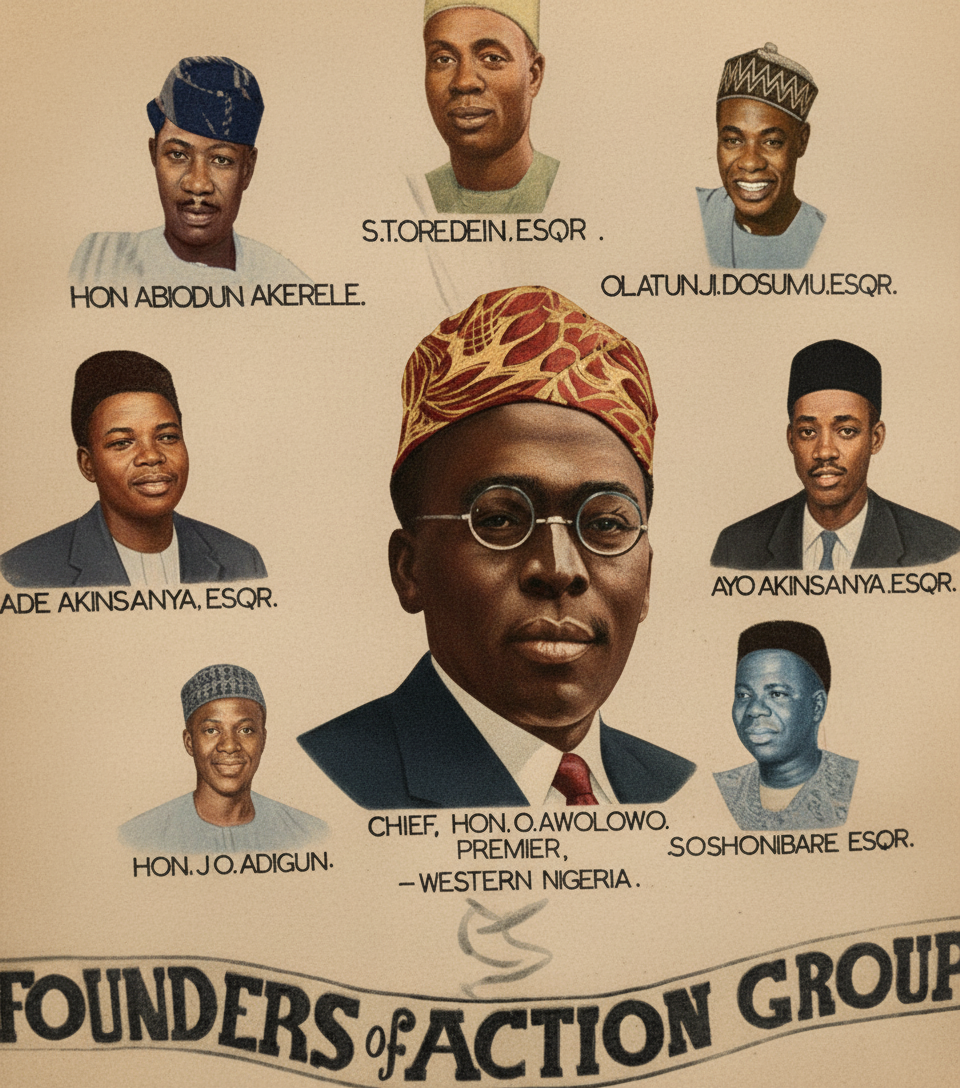
The Founders of the Action Group. S.O. Shonibare appears among the original nine men summoned by Chief Obafemi Awolowo to form the party in 1950.
He brought Nigerian Breweries, Guinness, the Nigerian Bottling Company, and Nigerian Textile Mills to Ikeja — helping them secure land in the industrial estate controlled by the Western Region Government. He saw the future of the mainland before anyone else did.
"Without you having to beg, he always went out of his way to do things for his staff. He assisted many people all over the country. He gave cheerfully." — Mr. Morakinyo Bajomo, his personal secretary for thirteen years
Chapter IV
The house was built on six acres of land — and it was a showpiece of mid-century Lagos.
Surrounded by a decorative fence with three entrances manned by ornate black gates, the compound contained the main house, a children's bungalow, two guest houses, staff quarters, and interconnecting covered walkways that expanded into rooftop patios built for entertaining.
The main house had a foyer with a spiral staircase sweeping to the first floor. A dining room seating sixteen. A private study lined floor to ceiling with wooden bookcases. Separate suites for husband and wife, each with bedroom, bathroom, and dressing room. A patio with built-in bar overlooking a fountain. The original drawings included a swimming pool, rejected for fear of the children drowning.
The entire compound had an alternate power supply fuelled by gas — decades before generators became standard in Lagos. When there were power outages, gas lamps would be lit throughout the estate.
Cappa and D'Alberto built it. It stood the test of time well into the modern era.
Chapter V
When the throne of the Awujale of Ijebuland became vacant in 1959, it was Shonibare who was sent to London to assess the young candidate — a twenty-five-year-old accountancy student named Sikiru Adetona.
They met for the first time at 45A Kensington Gardens, the residence of Chief M.S. Somole, Agent General for the Western Region. Shonibare kept the conversation informal, warm, but penetrating. He returned to Nigeria with his recommendation: this was the man.
On the 26th of October, 1959, the Afobaje — the council of kingmakers — unanimously selected Adetona. It was Shonibare who arranged the young king's homeward journey, collected him at the airport accompanied only by Muri Badmus and Tunde Amuwo, and drove him straight to Maryland Estate where he stayed in secret until the official announcement.
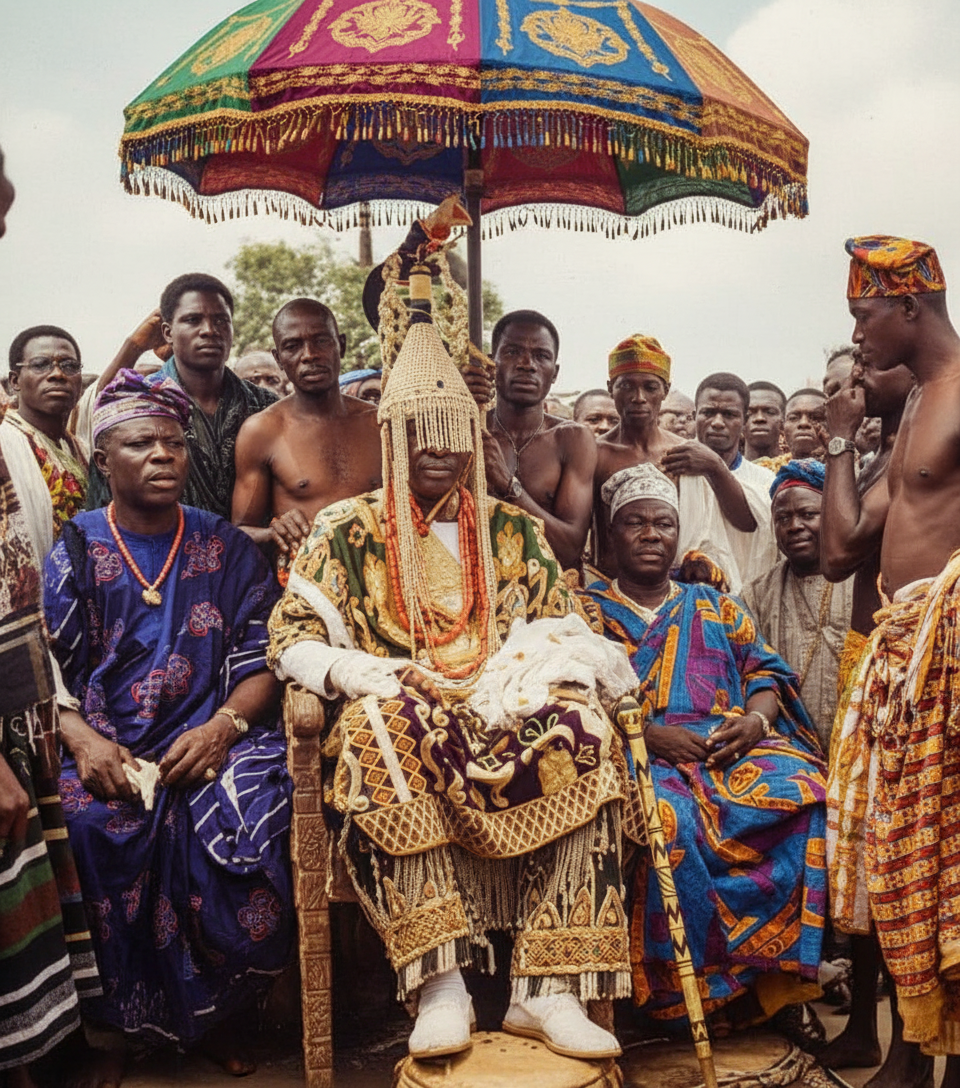
A traditional ceremony — the Awujale of Ijebu Ode flanked by chiefs including Shonibare, under the ceremonial umbrella of royalty.
In gratitude, one of the Awujale's first acts was to install Shonibare as the first Asiwaju of Ijebuland. Years later, when Shonibare purchased a parcel of family land from Adetona's father to support the succession campaign, Adetona returned it — free of charge.
"He advised that, as the Awujale, I must know how to relate with the elderly people, and secondly, that the custom of Obas greeting their subjects with horsetail had become outdated and I should consider discarding it. This is why I do not use a horsetail today." — Oba Sikiru Adetona, Awujale of Ijebuland
Chapter VI
Shonibare was one of the original nine men summoned by Obafemi Awolowo in 1950 to found the Action Group — the political party that would shape Western Nigeria's drive toward independence.
He became the party's Financial Secretary and its chief publicist. Through the National Investment and Properties Corporation, he oversaw the construction of Cocoa House in Ibadan — the first skyscraper in tropical Africa — along with Western House, Investment House, and the Bristol Hotel in Lagos.
He invented a mobile cinema operation: vans equipped with film projectors toured rural villages, screening Indian films with product advertisements and Action Group political messaging woven between the reels. The villagers would gather in their hundreds. It was quite possibly the most sophisticated grassroots campaign in West African history.
He also formed the West African Associates with Mr. Wadilove, the Consul for Iceland in Nigeria, importing newsprint and printing materials — and introducing stockfish to the Nigerian market for the first time. What began as a side venture became an important source of affordable protein for the nation.
Chapter VII
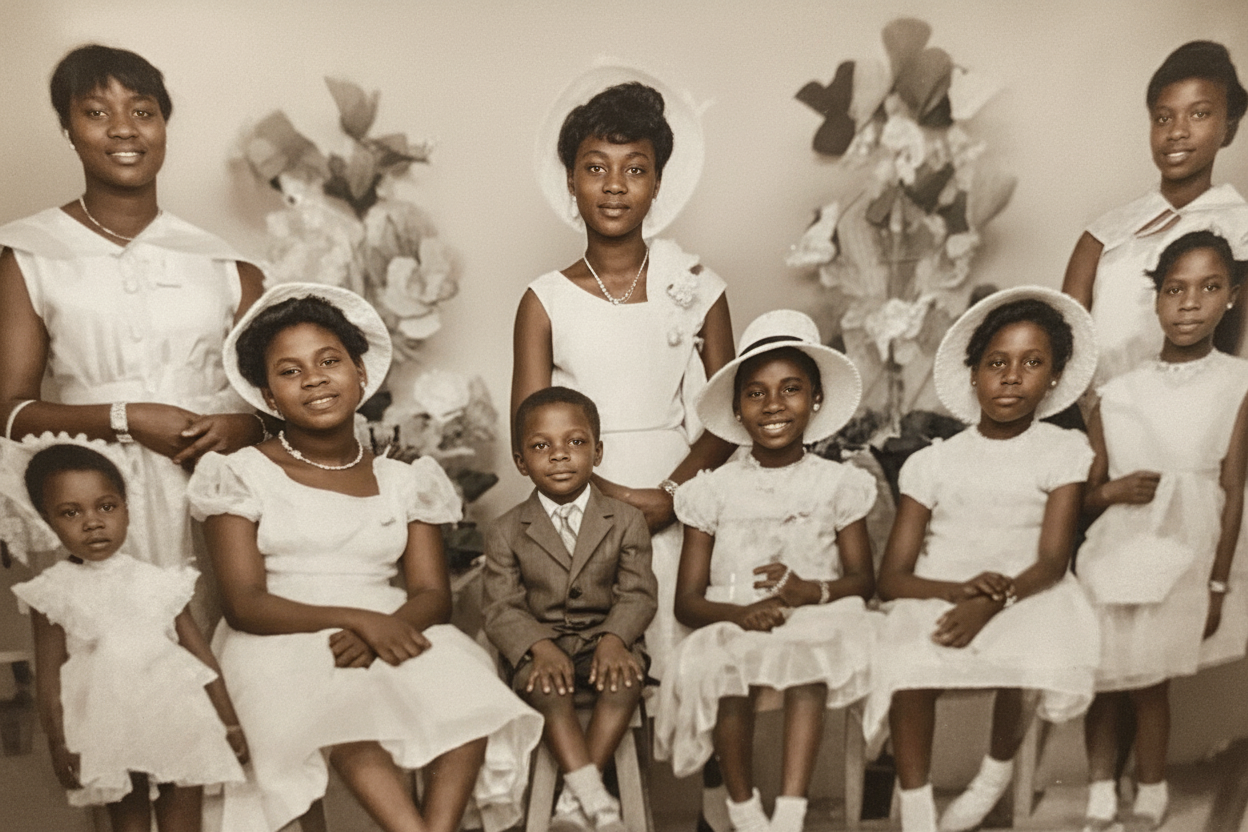
The Shonibare children in a formal portrait, circa 1960 — dressed for a family occasion in matching white dresses and suits, as was the custom of Nigeria's elite families.
He was, by all accounts, a devoted family man — though one who lived entirely on his own terms. He wore full Yoruba dress with an Awo cap and a walking stick (carried for style, not infirmity). Yet he rejected the custom of prostration, insisting his son should not do so. He demanded his children address each other by name, as the British did, rather than "brother this" or "sister that" — while simultaneously expecting absolute respect for the eldest.
Birthdays were celebrated with picnics at Bar Beach. There were family road trips to Ghana. He took his baths with his youngest children until they grew too old for it. When his wife complained about a particularly dim house help, he replied: "If she were more intelligent, she would not take on such a menial job and agree to serve you."
In 1961, he packed the five eldest children onto the MV Apapa for the two-week voyage to England and enrolled them in boarding school in Surrey. He had bought a flat at 21 Kensington Court Gardens — furnished with cherry wood from Maples, Wedgwood china, Waterford crystal, and silver cutlery. A chauffeur-driven Rolls-Royce took the children to school. He was among the first Nigerians to educate his children abroad at the primary and secondary level.
He also raised his late brother's two daughters as his own, giving them everything he gave his biological children. His brother Lamidi had died in a car accident at twenty-six. Shonibare had made a vow, and he kept it.
Chapter VIII
Politics in newly independent Nigeria was a blood sport. And when the Action Group split, Shonibare found himself in its path.
The falling out between Awolowo and his deputy Akintola tore the party apart. The Federal Government, seizing its opportunity, demanded immediate repayment of NIPC's construction loans — on projects still being built. Shonibare arranged alternative financing through Rothschild of London, whose representative spent three days inspecting the properties and confirmed they were worth multiples of the outstanding debt.
The Federal Government blocked the approval. The assets were seized and handed to WEMABOD. Thirty-nine Action Group leaders, including Shonibare, were arrested and detained.
He was restricted to Ondo — far from Lagos, far from his family, far from his doctors. His health began to deteriorate. A man who had never taken a day off work, who was always full of energy, began to visibly fail. He petitioned for permission to travel abroad for medical treatment. The petition was denied.
"Shonny, we did not steal anything. Awo always said that in politics we should be ready to be subjected to this type of thing. So don't bother yourself. All I know is that they will not kill us here." — Chief Alfred Rewane, Shonibare's closest friend, attempting to comfort him during his arrest
By the time the Coker Inquiry cleared him of all charges and he was finally permitted to leave, it was too late. On his way to Lagos, he stopped in Ibadan to see Awolowo. The party leader was shocked at the transformation — the robust, energetic man he remembered had become gaunt, thin, and obviously gravely ill.
Asiwaju of Ijebuland · 8 January 1920 — 17 January 1964
He died at the London Clinic on Friday the seventeenth of January, 1964. He was forty-four years old. His five eldest daughters were at boarding school in Surrey when the headmistress called them to her drawing room and said, "God has taken your father home."
He left behind eight children, a wife, a six-acre estate that was the showpiece of Lagos, and a legacy that shaped the city you see today.
A man who repaid every debt, kept every promise, and ran out of time before he ran out of vision.